
Transforming Buick for tomorrow
If “that’s not a Buick,” what is?
Buick has worked hard to shake off its decades-long old, tired reputation through fresh cars and strong marketing. But from this uncertain inflexion point, how should Buick be rebuilt for the future? And how can it reclaim its lost seat as a pioneering icon?
Halo car
We designed an autonomous, electric halo car that charts the future course of Buick. Our multi-specialty team tackled the numerous facets of vehicle development.
Defining the brand
My role evolved to define the holistic Buick experience and overall brand strategy. I worked with my peers to integrate our processes, findings, and design decisions.
Targeting progressive, premium clients
Pivoting away from traditional, middle-class buyers, Buick wants to attract younger, progressive, mid/upper-class clients.

Highly progressive “Changemakers” embody the future of Buick. “Well-Established” are slightly more traditional, but lucrative buyers. “Hustlers,” the younger clients, are a wildcard that inspire innovation.
The context map highlights relationships between buyers, the brand, and each other. Psychographic differences led to interesting conflicts between buyers; while “Fuerdai” is an interesting and viable group, their value orientation simply didn’t fit with our evolution of the brand.
Our target clients expect experiences with substance and change.
-
For tomorrow’s buyer, experiences are more valuable than material things, especially as a form of status. Buick doesn’t start and end with the car; every touchpoint must represent the branded lifestyle.
-
People are conscientious about their health, sustainability, corporate responsibility, and more. We need to create an authentic, approachable brand that customers will desire and respect.
-
Brands that disrupt and innovate at the cutting edge will prevail. In order to once again turn heads, Buick must set itself apart and create a truly different experience–through technology, service design, and product.
The way we engage is shifting
Buyers aren’t coming to the brand; the brand must reach out to them.
-
Aspects of car ownership, like delivery and servicing, can happen without any client action–the car delivers itself.
This technology could also realize and perfect ride share (perhaps a try-then-buy opportunity), shared ownership, and subscription ownership models.
-
Online presence, apps, and augmented/mixed reality can soon bring the full brand experience to the home.
-
Today, it’s all about pop-up shops and experiential marketing: experiences strategically located where clients spend their time, like malls, downtown, and events.


New purposes for place
-
Tech stores draw plenty of hype with their enticing style and interactive nature; some are even branded as social hotspots.
The dealership will need to break its stressful, stodgy stigma, and transcend its role as a place to buy and service–instead becoming a destination all its own. A place for brand discovery and delight.
-
On longer trips, recharging will be part of the journey. Instead of making an electric gas station, there’s the opportunity to turn downtime into a pleasing, branded experience.
The market is too macho and technocentric

Carmakers are notorious for playing games of, who can make more horsepower, or whose car is biggest in class, or who can slap on the biggest grille? Just look at all the brands chasing the Germans’ sport heritage, or Tesla’s Ludicrous Mode.
This is a phony, brand-first, and technocentric approach that pumps up a brand image for buyers to bend to, but that fails to meet the needs and values of tomorrow’s premium buyer.
When will a car brand make way for people, rather than having people make way for it?
Buick can be the antidote: a human-centered car brand
Between Buick’s design language, attainable positioning, and brand identity, the right building blocks are all there. GM needs to clarify the identity and put together excellence in product, marketing, and experience to truly communicate to the public Buick’s merit.
Better distinguishing GM’s brands—Chevy as stylish versatility, GMC as capable adventure, Cadillac as over-the-top prestige—will allow breathing room for Buick to shine as human-centered luxury.

Escape, and discover the Buick experience

In an overwhelming reality full of excess, noise, and overload, Buick provides a contrasting escape.
It’s not about image, exclusivity, or flash, but rather an effortless, authentic, natural lifestyle that’s delightful, yet responsible and inclusive.
This is true, sensible luxury that revolves around you.
Brand experience
Within built environments, the Buick brand is conveyed by the following “expressions”:
Healthy Mind / Body / World

-
Allow clients have a moment of relief from the stress of life. The end-to-end experience should be characterized by effortlessness and care.
Space achieve calmness through quiet and serene places, and attention restoration through biophilic design.
-
Support a healthy, wholesome lifestyle. The experience might consider thoughtful FF&E, refreshing food/drink, and brand collaborations.
-
The mission of autonomous, zero-carbon transportation is to create safer, more equitable mobility with a minimized impact on the environment.
Adaptive Reuse

-
Refitting an existing place has a reduced environmental impact compared to new construction.
Adaptive reuse can re-invigorate communities, reconnecting people with their roots, and galvanizing pride of place.
-
We can celebrate the unique history, culture, and identity of the location, creating a thoughtful experience.
By supporting environmental and social causes, the brand builds credibility and authenticity.
Brand equity & process
A variety of thought-starting programming, service design, and interiors studies:




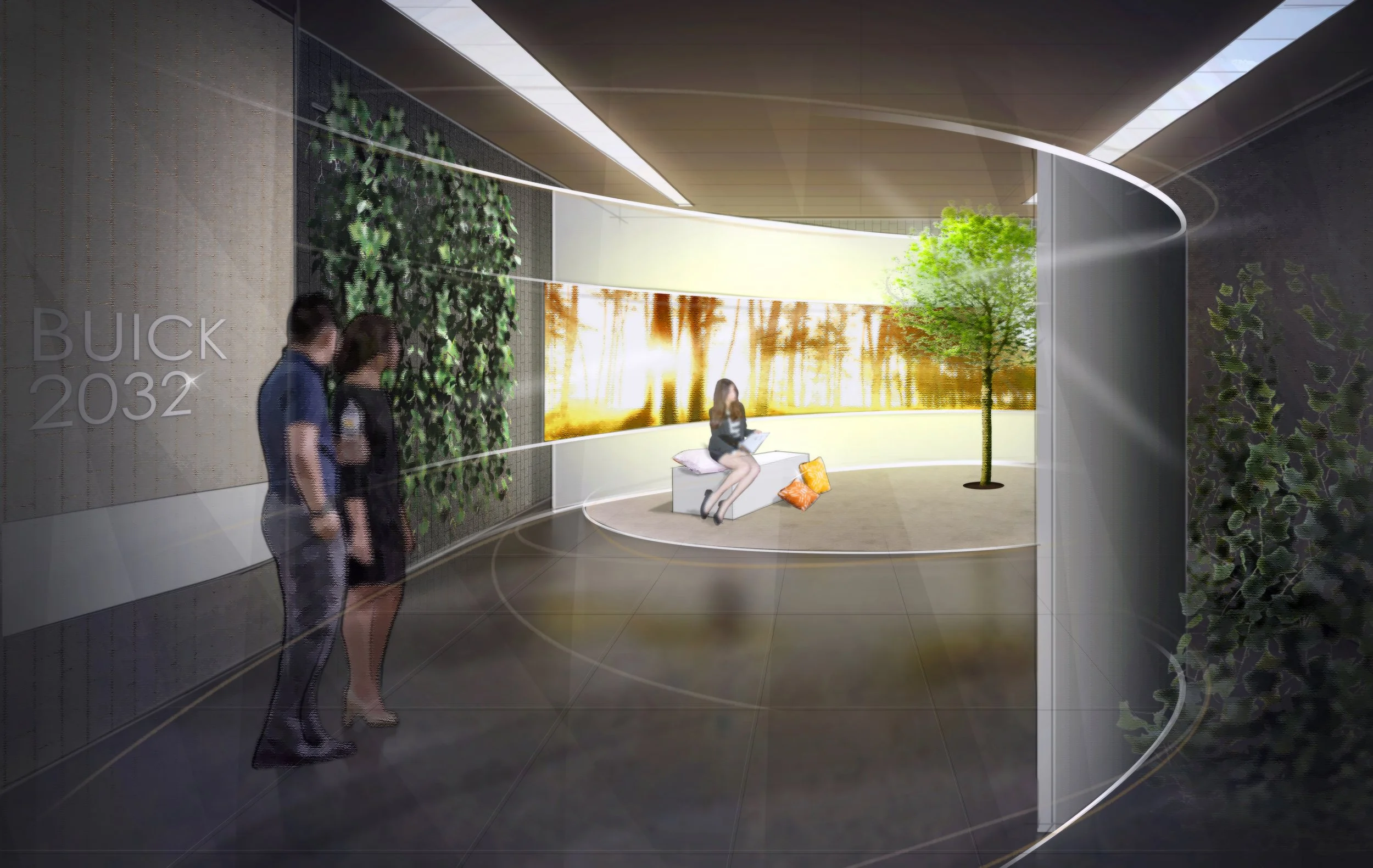
Imagining branded pop-ups
-
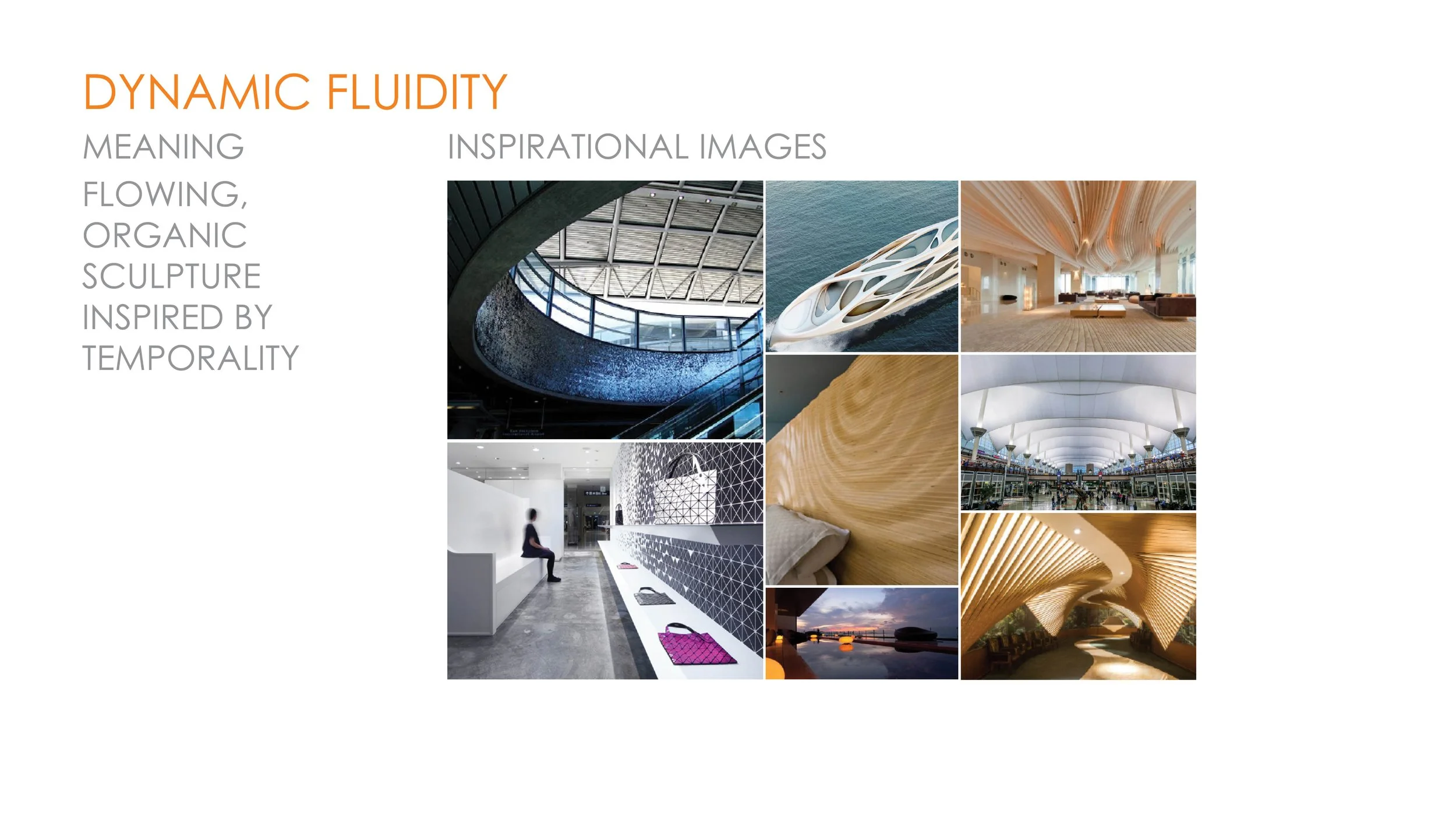
Layers of organically wrapping and peeling surfaces that both welcome and cocoon. This pop-up uses a mix of solid, mesh, and living green walls to balance privacy and invitation.

-
Inspired by mollusks. Explicitly offers shelter and protection, giving foundation to the idea of escape. This exemplar blends into the natural environment. The clam shell distinguishes inside from outside without closing people off. It can also “open” for dramatic reveals.

-
A series of cyclical geometries found in meteorology, living beings, and light. The example uses sustainable materials to create a structure of rings and tubes, wrapped in a flexible mesh. Its location on a plaza shows the boldness of its organic form.


Halo Car
Unpretentious and right-sized, this autonomous, electric crossover is the perfect escape.
Essential beauty
Inspired by creating “a most beautiful pebble,” the form focuses on proportion and clean, essential sculpture. Subtle surfacing creates graceful movement.

A restorative sanctuary
Passengers are enveloped in inviting, natural materials and textures, in a quiet, comfortable cabin. The translucent greenhouse and refraction projection evoke sitting under the forest canopy.

Vehicle design by Katelyn Kleinhenz and John O’Laughlin. In collaboration at General Motors.